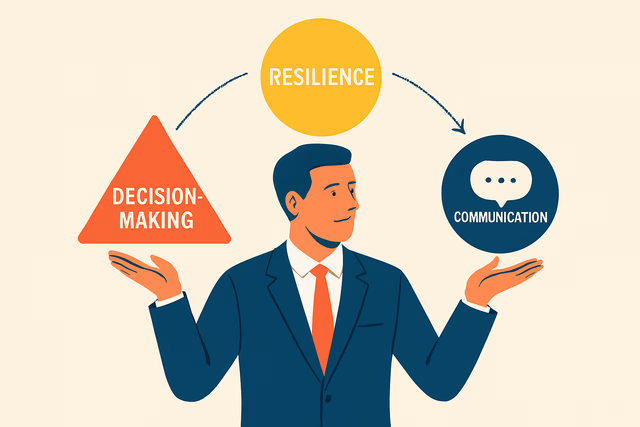
For you as a CMO, emotionally intelligent communication is a strategic leadership capability, not a nice interpersonal extra. Your CMO communication skills are tested when pressure rises, timelines tighten, and different teams need different things from the same decision. If your words promise flexibility while your actions signal urgency, people do not experience nuance; they experience drift.
Why emotionally intelligent communication breaks under pressure
Mixed signals rarely start with bad intent. They usually start with unresolved priorities, unmanaged pressure, and the quiet hope that you can satisfy everyone if you phrase things carefully enough. That hope does not hold for long.
Here is what often happens. You leave a leadership meeting having heard three competing demands: protect the brand, hit the date, control the spend. You then speak to each audience through the lens of its concern. Creative hears, “We still want the best idea.” Sales hears, “We need simpler messaging now.” The executive team hears, “The plan is on track.” None of those statements is entirely false. Together, they create confusion.
Teams can handle a hard priority. They struggle with a blurry one.
That is why emotionally intelligent communication for leaders matters so much in marketing. You are not simply moving information around. You are converting pressure into signal. When you have not decided what matters most, your communication carries your tension instead of your direction.
And people notice faster than leaders think. A team does not need a contradiction in writing to feel one. They hear it in what you emphasize, what you soften, and what you postpone saying clearly.
What creative team leadership and cross-functional team communication need from you
Creative and cross-functional teams are not asking for the same message, but they are listening for the same cues: Do you understand the stakes, do you know what matters most, and will that answer still be true tomorrow?
Your creative team needs context before critique. If you tell them to “be bolder” on Monday and then strip out every risky edge on Wednesday without naming what changed, they do not experience strong creative team leadership. They experience unpredictability. Empathy without direction feels kind; direction without empathy feels careless. You need both in the same sentence.
Your peers outside marketing need something slightly different. Product wants to know whether messaging changes will create downstream churn. Sales wants to know what the field should say now, not after one more round. Finance wants to understand whether a delay is strategic or simply late. They do not need your internal debate. They need the decision, the trade-off, and the implication.
Picture a campaign review where you tell the team, “Let’s keep pushing the idea,” then later tell sales, “We’re simplifying because the concept is too clever for the market.” Even if both statements came from a reasonable instinct, you have now taught the organization that your message changes by room. Trust weakens there.
Tone sets safety; specificity sets speed.
That is the central tension of leadership communication under pressure. You cannot choose between empathy and precision. If you sound calm but stay vague, teams hesitate. If you sound sharp but skip the human reality, teams comply without commitment.
Grow Faster With a Peer Group
Join a curated group of leaders who meet regularly to share challenges, exchange insights, and hold each other accountable. Leadership doesn't have to be lonely.
Explore Peer GroupsIn high-stakes conversations, name the tension before you name the ask
One of the cleanest ways to reduce mixed signals is to say the conflict out loud before you issue direction. High-stakes conversations improve the moment you stop pretending the trade-off is invisible.
Instead of saying, “We just need to stay agile here,” say what is actually true: “We are trying to preserve the distinctiveness of the campaign, but launch timing matters more than another week of polish.” That sentence does two things at once. It shows people you see the competing values, and it removes ambiguity about the decision.
A short scene will feel familiar. The COO asks for an AI roadmap. The CIO delivers a capability timeline. Meanwhile, the support team has already deployed AI routing because ticket volume forced the issue. The problem is not effort. The problem is that nobody named the real tension: experimentation versus standardization, now versus later, local speed versus enterprise coherence.
Marketing has its own version of this every day. Brand versus demand. Message quality versus launch speed. Team morale versus executive urgency. When you name the tension cleanly, people stop guessing what game they are in.
Do not rush past that moment with overly polished reassurance. People relax when the hidden conflict becomes explicit. Once the room can see the trade-off, it can work with it.
A playbook sequence for CMO communication skills under pressure
You do not need a giant framework when a conversation is going sideways. You need a sequence you can run in real time, especially when stakes are high and attention is short.
Start with the pressure in the room
Before you redirect the team, acknowledge what is making the moment hard. That might be timeline compression, executive scrutiny, or the fact that one group is being asked to absorb the consequence of another group’s decision. This is not emotional theater. It is orientation. If you skip it, people spend the next ten minutes wondering whether you see what they see.
Name the tension in one sentence
Force yourself to state the actual conflict with no filler. “We want a sharper idea, but we are no longer optimizing for originality; we are optimizing for launch confidence.” Or: “We need one story across channels, even if that means dropping the cleverest version.” A named tension reduces anxiety because it replaces ambient pressure with shared reality.
Put the priorities in order
Not side by side. In order. This is where mixed signals either die or spread. Say what wins if there is a collision. “For this launch, message clarity beats feature completeness.” “This week, field usability beats campaign elegance.” Change the level of detail if you need to. Do not change the hierarchy.
Close with who will do what next
The emotional part of leadership is not complete when the room feels heard. It is complete when people know what happens after the meeting. Confirm ownership, timing, and what will stay stable across audiences. Follow-through is where trust and clarity in leadership communication become visible. Message, tone, and next step have to match.
Under pressure, people do not need more interpretation. They need fewer competing instructions.
Join a Digital Leadership Session
Our facilitated digital sessions bring leaders together for focused, interactive discussions on the topics that matter most. Learn from peers across industries — from anywhere.
View Digital SessionsHow to avoid mixed signals at work when different stakeholders need different messages
This is where many marketing leaders get stuck. You know different audiences need different language, so you start tailoring aggressively. Done well, that is translation. Done poorly, it becomes inconsistency with better vocabulary.
The rule is simple: change the emphasis, not the meaning. Your CEO may need the business implication. Sales may need the talk track. Creative may need the rationale behind the constraint. Those are different versions of the same decision, not three different decisions.
Say you are delaying a campaign by one week. To the executive team, you might say, “We are protecting launch quality because a confused market entry will cost more than a short delay.” To sales, you say, “Hold the old narrative for one more week; new enablement lands Friday.” To creative, you say, “We are using the extra week to tighten the story, not to reopen the concept.” Different framing. Same center.
Another scene: the CEO asks whether paid performance can cover for a weaker product story. If you tell finance that media can solve the gap, tell your team the same truth: paid can amplify clarity, not replace it. Change the level of detail, not the substance. That is how cross-functional team communication stays coherent.
Consistency is not repetition. It is integrity across rooms.
Reframing emotionally intelligent communication as operating discipline
It helps to stop treating emotionally intelligent communication as a matter of personality. This is not about whether you are naturally warm, naturally calm, or especially good at reading a room. It is about whether you can hold empathy and precision together when the organization is under strain.
Seen that way, mixed signals are not a tone problem. They are usually a sequencing problem, a priority problem, or a follow-through problem. Your communication style does not just reflect alignment; it creates the conditions for it.
So the real shift is this: your job is not to make hard moments feel soft. Your job is to make them clear enough that people can move together anyway. Emotionally intelligent communication is not softer leadership. It is disciplined leadership that sounds human.
Accelerate With 1-on-1 Coaching
Work with an experienced coach to develop your leadership style, navigate complex decisions, and unlock your full potential. Personalized guidance, real results.
Apply for Coaching
Written by
Christopher A. SmithChristopher A. Smith is an award-winning, visionary technology leader and entrepreneur passionate about harnessing the collective wisdom of experts to tackle the world's most complex challenges. With over 20 years of leadership and management experience, Christopher has distinguished himself as a pioneer in driving innovation and fostering collaborative ecosystems where ideas flourish and solutions emerge. Christopher's philosophy centers on the conviction that no challenge is too daunting to overcome when individuals come together, pooling their knowledge, skills, and creativity. His career is a testament to the potential of collective intelligence to drive meaningful change, embodying the ideal that there lies the strength to transform the world in unity. Chris is always eager to share his knowledge and experience by speaking at conferences and events. He is passionate about using his skills to contribute to philanthropic organizations and causes where he can make a positive impact.
View all articles