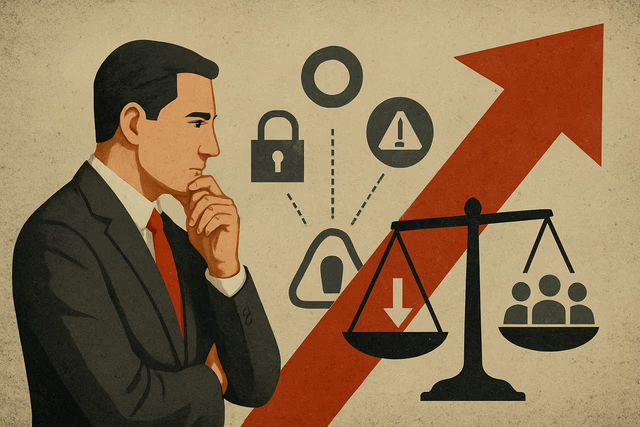
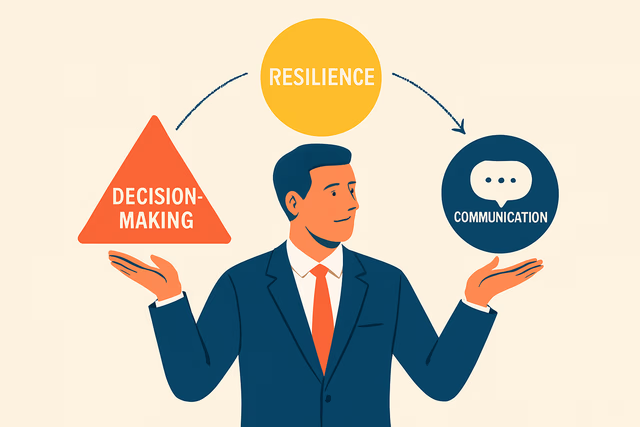
Enterprise IT leaders are asked to do two things that pull against each other: protect the core and change it. That contradiction is exactly where innovation inspiration tends to get lost. CIOs do not run out of ideas in legacy-heavy environments; they run into constraints they treat as vetoes instead of design inputs. If you want innovation inspiration for CIOs to become something more than a workshop theme, you need an operating model that turns caution into a credible starting point.
Why innovation inspiration for CIOs gets trapped in the wrong debate
The wrong argument dominates too many modernization conversations. One side says the estate is too fragile, too regulated, too interconnected to experiment. The other says real transformation requires boldness, speed, and a willingness to disrupt old patterns. Both positions contain some truth, and both are operationally useless.
What actually stalls progress is not lack of ambition. It is lack of translation. Security sees exposure. Operations sees instability. Business leaders see delay. Architecture sees technical debt. Everyone is reading the same legacy constraint through a different lens, so the organization debates transformation in the abstract and avoids making a design choice in the concrete.
A legacy constraint is rarely a stop sign. More often, it is a label on what the business cannot afford to break.
Consider the meeting where the COO asks for an AI-enabled service roadmap. The CIO can answer with a three-year capability plan, but the support leader is worried about knowledge quality, security is worried about data exposure, and the platform team is worried about another integration on a brittle stack. Nothing is wrong with the ambition. The failure is starting at the top of the idea stack instead of the bottom of the risk stack.
That shift matters because legacy modernization does not win on rhetoric. It wins when people can see the boundary, the consequence, and the proof.
The constraint-to-confidence model for innovation in legacy systems
If constraints are inputs, the design question changes. Instead of asking, "How do we innovate despite the estate?" ask, "What is this constraint telling us to protect, and what kind of experiment can live safely inside that boundary?"
The model is simple enough to use in a live portfolio discussion and disciplined enough to stop vague transformation theater. I think of it as a four-part constraint-to-confidence loop:
- Name the protected asset. Identify what the organization is really defending: uptime, regulatory exposure, customer trust, close-cycle accuracy, margin, or team capacity.
- Find the operational friction. Pinpoint where the constraint creates recurring cost, delay, rework, or handoffs that the business already feels.
- Set the blast radius. Define the smallest environment in which you can test improvement without destabilizing core operations.
- Choose the proof. Decide what evidence would make skeptical stakeholders say yes to the next move.
This is not a prioritization exercise dressed up as a framework. It is a way to design innovation in legacy systems so the first step is bounded, intelligible, and worth defending.
Risk is not the enemy of innovation; unmanaged blast radius is.
The important distinction is between constraints that shape a design and constraints that genuinely forbid action. Those are not the same category. A bank may not be able to re-platform a core payment engine on an executive timeline. It may still be able to automate exception handling around it, isolate reporting workloads, or modernize a customer-facing process that depends on the engine without touching the engine itself. The estate stays intact. The innovation surface changes.
Grow Faster With a Peer Group
Join a curated group of leaders who meet regularly to share challenges, exchange insights, and hold each other accountable. Leadership doesn't have to be lonely.
Explore Peer GroupsRead risk, security, and fatigue as design signals
CIOs get into trouble when they flatten all caution into one word: resistance. Risk sensitivity, security concern, and change fatigue look similar from a distance, but they tell you different things.
Risk sensitivity usually points to consequence. If a workflow touches revenue recognition, claims adjudication, or production scheduling, the organization is telling you that recovery costs are high. Security concern points to boundary. It tells you where data, access, or integration patterns need to be constrained. Change fatigue points to capacity. It tells you the organization may accept a better process, but not another enterprise-wide program layered on top of existing strain.
That distinction sharpens opportunity selection. If the issue is consequence, start with adjacent processes rather than the transactional core. If the issue is boundary, design for isolation and limited data movement. If the issue is capacity, target automation that removes effort before you ask teams to adopt new behavior.
A manufacturer I worked with could not get traction on a broad ERP modernization discussion. Too much money, too much history, too many dependencies. But one constraint was unusually clear: planners were manually reconciling inventory exceptions across systems every morning because no one trusted the overnight sync. That was not just a symptom of legacy. It was the opening. The team built a narrow exception-management layer and validated alerts against known error classes before touching anything deeper. The experiment did not modernize the estate. It made the next modernization decision possible.
Constraints do not merely slow the queue. They reveal where the queue hurts.
Use enterprise transformation experiments to shrink belief gaps
Once you read the constraint correctly, the next move is not to draft a grand program. It is to design a bounded experiment that closes a belief gap.
The best enterprise transformation experiments are not pilots in the loose corporate sense of the word. They are proofs with edges. They answer a precise question for a precise set of skeptics. Can we reduce manual review time without expanding data exposure? Can we improve service resolution without changing the system of record? Can we modernize a customer-facing interaction while keeping the batch backbone untouched?
A useful experiment has three qualities. First, it sits near a known operational pain point, not a speculative future state. Second, it has a visible safety case, so people understand what will not change. Third, it generates evidence that travels beyond the immediate team.
Picture a claims environment where adjusters swivel between three screens because the legacy platform cannot present context cleanly. Replacing the platform is a board-level conversation with a long runway. A low-regret experiment might assemble a read-only workbench that surfaces claim history, document status, and policy context in one place while leaving the core transaction flow untouched. If cycle time drops and errors do not rise, the organization has learned something more valuable than whether a tool works. It has learned that modernization can happen without detonating the operating model.
Transformation momentum does not begin with a roadmap; it begins with a result nobody has to explain away.
Join a Digital Leadership Session
Our facilitated digital sessions bring leaders together for focused, interactive discussions on the topics that matter most. Learn from peers across industries — from anywhere.
View Digital SessionsCross-functional trust in IT is part of the architecture
This is where many CIO innovation strategies collapse. The technical design is careful, the use case is sensible, and the value case is clear enough. But the surrounding coalition is weak. Security was consulted late. Operations feels change is being done to them. Finance hears spending before it hears containment. The experiment may still launch, but it will not compound.
Cross-functional trust in IT is not a soft cultural side quest. It determines how much proof the organization requires before allowing the next step. High-trust environments tolerate ambiguity because prior experiments were contained and transparent. Low-trust environments demand certainty that no CIO can honestly provide.
Trust is built less by vision than by surviving the first experiment together.
That means the operating model must specify participation, not just sponsorship. The teams closest to risk need a role in defining the blast radius and the evidence threshold. The business owner needs to help name the operational friction, not merely approve the budget line. The architecture team needs to document what was intentionally left untouched. Those choices lower political temperature because they make the experiment legible.
You can see the difference in the room. In one organization, a proposal for automated case summarization triggers a circular argument about model risk, user adoption, and platform standards. In another, the same proposal moves quickly because the group has already agreed on data boundaries, fallback procedures, and a limited user cohort. Same idea. Different trust architecture.
Modernizing legacy environments by compounding low-regret wins
Low-regret experiments are often dismissed as too incremental. That is usually a category error. Incremental is not the same as trivial. A narrowly scoped win can change the organization's appetite, sequencing, and language around modernization.
The point is not to accumulate disconnected pilots. The point is to create a chain of proofs that changes what the enterprise believes is safely possible. One experiment proves a data boundary can hold. The next proves a workflow can improve without touching the system of record. The next proves a cross-functional team can make a decision in weeks instead of quarters. By the time larger platform work comes back onto the agenda, the debate is no longer theoretical.
This is the part senior leaders often miss: modernizing legacy environments is as much a confidence problem as a technology problem. If the organization has been burned before, every new proposal gets priced against that memory. A low-regret experiment does more than deliver local value. It resets the memory.
So the adoption path is straightforward, though not simplistic. Pick one major constraint that keeps resurfacing in strategic discussions. Name what it is protecting. Locate the friction it is creating. Design the smallest experiment that can improve the friction while honoring the protection. Then choose proof that matters to the people who will have to support the second move, not just celebrate the first.
The deeper reframe is this: legacy constraints are not evidence that innovation has less room to operate. They are evidence that innovation has to be designed with sharper edges. The estate is not the opposite of invention. In a mature enterprise, it is the material invention has to work with.
Accelerate With 1-on-1 Coaching
Work with an experienced coach to develop your leadership style, navigate complex decisions, and unlock your full potential. Personalized guidance, real results.
Apply for Coaching
Written by
Christopher A. SmithChristopher A. Smith is an award-winning, visionary technology leader and entrepreneur passionate about harnessing the collective wisdom of experts to tackle the world's most complex challenges. With over 20 years of leadership and management experience, Christopher has distinguished himself as a pioneer in driving innovation and fostering collaborative ecosystems where ideas flourish and solutions emerge. Christopher's philosophy centers on the conviction that no challenge is too daunting to overcome when individuals come together, pooling their knowledge, skills, and creativity. His career is a testament to the potential of collective intelligence to drive meaningful change, embodying the ideal that there lies the strength to transform the world in unity. Chris is always eager to share his knowledge and experience by speaking at conferences and events. He is passionate about using his skills to contribute to philanthropic organizations and causes where he can make a positive impact.
View all articles