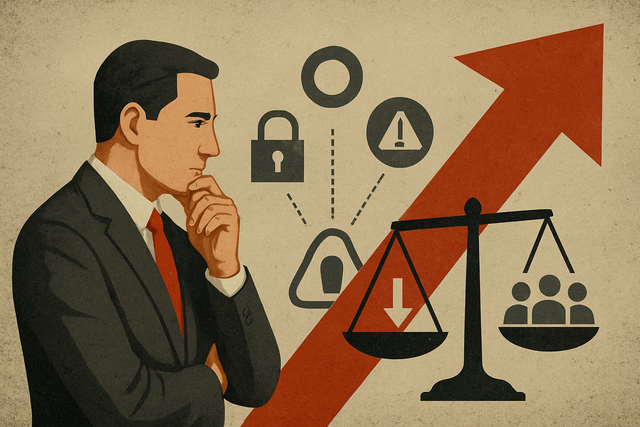
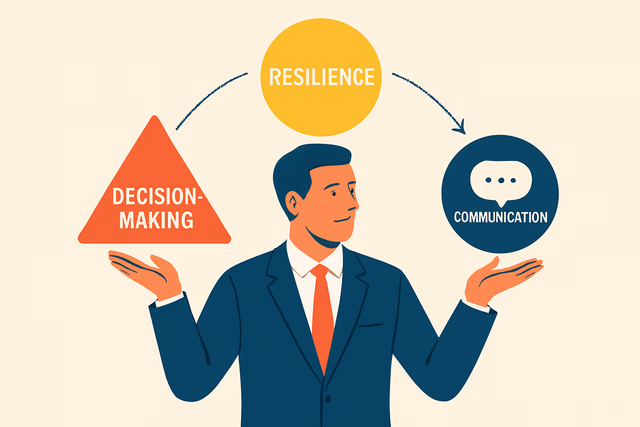
You are expected to carry the transformation decision, and you should. You are also expected to recognize when your own line of sight is too narrow to carry it well. That is the contradiction at the center of collective wisdom: the decision stays with you, but the judgment improves when the enterprise is allowed to inform it. Under pressure, solo authority feels decisive; in reality, it often just hides missing context.
Why technical authority stops short in enterprise transformation strategy
Enterprise transformation rarely stalls because the architecture is impossible. It stalls because risk is interpreted differently across functions, because change fatigue shows up before the dashboard catches it, and because cross-functional resistance is usually a signal of competing realities, not simple obstruction.
You see this in the room. The COO asks for a faster platform rollout. Security wants another control review. HR is already hearing from managers who have absorbed three reorganizations in eighteen months. The technology plan may be coherent, but the enterprise is sending back strain.
Technical authority can settle design standards, vendor choices, and target-state logic. It cannot, on its own, resolve whether the business is ready to absorb another step change. That is why collective wisdom for CIOs matters most when the issue is not technical correctness but organizational consequence.
A sharp transformation leader learns this early: certainty travels faster than trust, but trust travels farther. If you want decisions that survive contact with the business, you need more than expertise. You need a system for hearing what your title does not automatically reveal.
Collective wisdom is not consensus for its own sake
Collective wisdom gets dismissed when people confuse it with consensus theater. That is fair; plenty of organizations invite input only to slow the decision or spread responsibility so thin that nobody owns the outcome.
That is not the model you need. Collective wisdom is structured input to better leadership judgment. It is not a vote. It is not a permission slip. It is not an attempt to make every stakeholder equally satisfied.
The distinction matters because transformation decisions often involve asymmetric consequences. The infrastructure lead may see operational risk before anyone else. The finance partner may spot cost timing the program office has smoothed over. A business unit head may recognize resistance that is really a revenue protection instinct. Those views should not carry equal weight in every decision, but they should be designed into the process.
Consensus dilutes responsibility; collective wisdom sharpens judgment. A decision can be collectively informed and singularly owned. If you lose that distinction, you either drift into committee rule or snap back to executive isolation. Neither gives you durable transformation strategy.
Grow Faster With a Peer Group
Join a curated group of leaders who meet regularly to share challenges, exchange insights, and hold each other accountable. Leadership doesn't have to be lonely.
Explore Peer GroupsA practical collective wisdom framework for CIO decision-making
What you need is not more opinions. You need better signal architecture. A workable model has four moves:
- Frame the decision. State the choice, the trade-off, and the time horizon clearly enough that people react to the real issue rather than their preferred version of it.
- Gather targeted insight. Pull input from the people who see different forms of consequence: operational, financial, human, regulatory, and customer-facing.
- Filter for decision relevance. Separate evidence from preference, local pain from enterprise risk, and loud objections from consequential ones.
- Apply and declare. Make the call, explain what changed your thinking, and show what input was heard even if it did not win.
This sounds simple, but simplicity is the point. Under transformation stress, complex decision rituals collapse first. A usable framework has to survive the week before a go-live, the quarter-end funding review, and the executive meeting where everyone arrives with a different definition of urgency.
The framing step is where many CIOs either save or lose the process. If you ask, “Should we proceed?” you invite ideology. If you ask, “What risk increases if we move now, and what risk increases if we wait?” you invite judgment. The quality of the answer depends on the quality of the question.
Design the input network around risk, fatigue, and cross-functional resistance
Once the decision is framed, the next issue is who gets into the signal path. Not everyone needs a seat in every decision, and pretending otherwise creates noise you later have to fight through.
Build your collective wisdom network around vantage point, not hierarchy. For one transformation choice, your best input may come from the infrastructure head, the finance lead, and the customer operations executive. For another, it may come from regional leaders who know where process workarounds already exist and where they will snap under another imposed change.
A short example makes the point. A CIO is preparing a major ERP process redesign. The steering group is comfortable. Then a divisional operations leader says plant managers are still manually reconciling last quarter's reporting changes. That is not resistance to progress; it is an early warning about absorption capacity. Change fatigue leadership starts by treating fatigue as data, not weakness.
The same principle applies to peer insight. A fellow CIO who has already run a similar migration may see a dependency your program team normalized months ago. Shared leadership insight often arrives as pattern recognition: not a better idea in the abstract, but a clearer read on what breaks first.
Choose inputs for contrast, not comfort. If everyone around the decision interprets risk the same way you do, you do not have collective wisdom. You have reinforcement.
Join a Digital Leadership Session
Our facilitated digital sessions bring leaders together for focused, interactive discussions on the topics that matter most. Learn from peers across industries — from anywhere.
View Digital SessionsFilter stakeholder feedback in transformation before it hardens into noise
Gathering input is the easy part. Filtering it is where leadership earns its keep.
Stakeholder feedback in transformation usually comes mixed. Some of it is evidence. Some of it is anxiety. Some of it is turf defense wearing the language of enterprise concern. If you treat all three as equivalent, you will either overreact or stop listening altogether.
Use three filters. First, ask whether the input changes the consequence profile of the decision. Second, ask whether the source has direct exposure to that consequence or is reacting from distance. Third, ask whether the concern is local, recurring, or systemic. You are not trying to eliminate disagreement. You are trying to locate what kind of disagreement you are dealing with.
Consider a cloud operating model change. The application team says the timeline is unrealistic. The platform team says it is fine. The service desk says ticket volumes have already climbed during pilot waves. Only one of those inputs tells you what the organization is experiencing in real time. Transformation fails less from bad intent than from missing context.
Filtering also protects the process from becoming political theater. People can live with a decision they dislike if they believe the input was weighed intelligently. They resist hardest when they suspect the listening was ceremonial.
Make visible integration the core of trust and decision resilience
Listening helps only when people can see that listening mattered. This is where trusted transformation strategy is built: not through endless consultation, but through visible integration of insight.
Visible integration is straightforward. You make the decision. You explain the factors that moved it. You name the risk that remains. You identify what you heard and what you chose not to act on yet. That final part matters more than leaders sometimes realize.
A brief scenario: the CIO proceeds with a phased rollout rather than a big-bang cutover. In the readout, she says the sequence changed because regional operations surfaced adoption strain and customer support flagged a service-volume spike in the pilot. She also notes that finance pushed for a faster savings curve, but the organization would pay for speed with instability. Trust grows because the enterprise can see the reasoning, not just the verdict.
This is how decision resilience improves. Blind spots surface earlier. People stop assuming resistance is ignored. Peer and stakeholder input become part of the transformation governance fabric without turning every choice into a negotiation.
Trust is not built by asking for input. It is built when people can trace their input to the shape of the decision, or understand clearly why it did not prevail.
Accelerate With 1-on-1 Coaching
Work with an experienced coach to develop your leadership style, navigate complex decisions, and unlock your full potential. Personalized guidance, real results.
Apply for CoachingThe CIO role is not to carry the enterprise alone
The final design choice is personal. You have to decide what strength looks like in the chair.
If you define strength as solitary certainty, you will keep making transformation decisions that are clean on paper and brittle in the organization. If you define strength as disciplined judgment informed by the right people at the right moment, your decisions may feel less dramatic, but they will hold longer.
That is the real value of collective wisdom for CIOs. It is not a softer leadership style. It is a more accurate one. You are not lowering the authority of the role; you are improving its range. The CIO who listens with structure is not giving the enterprise a vote on every move. You are building a better instrument panel for decisions that already belong to you.
Seen that way, collective wisdom is not a hedge against leadership. It is one of the few ways to practice leadership honestly in a transformation large enough that no single executive can see the whole field.

Written by
Christopher A. SmithChristopher A. Smith is an award-winning, visionary technology leader and entrepreneur passionate about harnessing the collective wisdom of experts to tackle the world's most complex challenges. With over 20 years of leadership and management experience, Christopher has distinguished himself as a pioneer in driving innovation and fostering collaborative ecosystems where ideas flourish and solutions emerge. Christopher's philosophy centers on the conviction that no challenge is too daunting to overcome when individuals come together, pooling their knowledge, skills, and creativity. His career is a testament to the potential of collective intelligence to drive meaningful change, embodying the ideal that there lies the strength to transform the world in unity. Chris is always eager to share his knowledge and experience by speaking at conferences and events. He is passionate about using his skills to contribute to philanthropic organizations and causes where he can make a positive impact.
View all articles