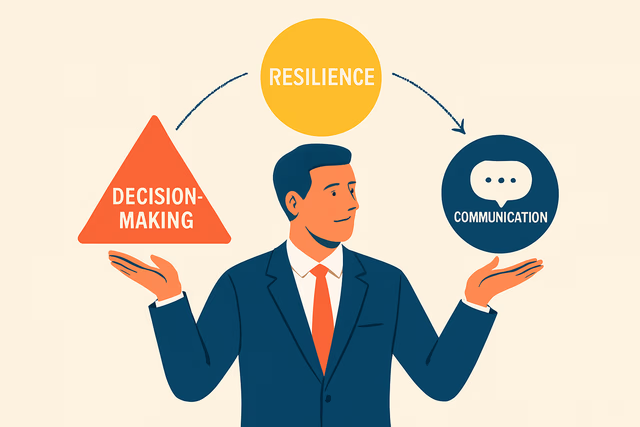
Enterprise transformation leadership exposes a quiet truth: the higher you rise, the less your expertise can carry a strained room on its own. Personal growth for CIOs is not a private side project you work on between budget cycles; it is part of how you lead when scrutiny is high, stakes are real, and your counterparts need more than a correct answer. If you want stronger cross-functional trust for CIOs, you have to look at the part of leadership that shows up in tone, timing, restraint, and reflection.
Personal growth for CIOs begins where technical certainty ends
The job changes before the title does. Early in your career, being right buys you room. As CIO, being right but unreadable can cost you the room anyway.
You can feel this in the meeting where an ERP delay lands on the executive agenda. You explain dependencies, data migration risks, and why forcing the cutover would create larger operational problems. Technically, your answer is sound. But the COO is hearing disruption, the CFO is hearing exposure, and the CEO is noticing that you sound irritated by the question itself. The problem in that moment is no longer the plan. It is your presence.
That is why CIO leadership development has to include self-observation under pressure. Not as therapy. Not as image management. As leadership hygiene. Transformation does not test your architecture first; it tests your self-command.
The useful question is not, "Did I explain it clearly?" It is, "What happened to my judgment when the room got tense?" You may discover that you get faster when you feel challenged, more detailed when you feel mistrusted, or sharper in tone when you think people are oversimplifying the work. Those habits are understandable. They are also expensive.
There is a caveat here. Self-awareness is not the same as self-consciousness. If you start over-monitoring every phrase, you become stiff and overly managed, which people read as distance. The point is not to perform calm. It is to know your patterns well enough that they do not perform you.
A room will forgive uncertainty faster than it forgives defensiveness. That is one of the quieter truths of executive life, and it is where personal growth for CIOs starts to become a practical advantage rather than a private aspiration.
CIO self-awareness changes communication with non-technical stakeholders
The gap between what you mean and what they hear is often smaller than you think and more consequential than you want. CIO self-awareness matters because communication with non-technical stakeholders is not a translation exercise after the fact; it begins with knowing what language you reach for when you are under heat.
Consider the budget review where the CFO asks why a platform investment needs another quarter before benefits show up. You answer with integration complexity, vendor sequencing, and security review timelines. None of that is wrong. But she is not asking for a systems lecture. She is testing whether you understand the cost of delay in her terms, not yours.
When you know your own defaults, you can adjust before trust erodes. You can say: the delay matters because it keeps working capital tied up in manual work, extends reporting risk, and asks business teams to live in two processes longer than they should. Same reality. Different leadership move.
That shift is not cosmetic. It tells your peers that you respect the logic they operate under. If they have to translate you before they can trust you, you have already made the work harder.
Still, there is a lazy version of this advice that is worth rejecting. Communication with non-technical stakeholders does not mean flattening every issue into a slogan or pretending trade-offs are simpler than they are. Good leaders do not water down reality. They sequence it. First consequence, then complexity. First decision, then detail.
You can see the difference immediately. One style says, "Here is the architecture rationale." The other says, "Here is the business exposure, here is the technical constraint behind it, and here is the decision the room actually needs to make." Credibility grows when people feel you are helping them carry the decision, not admire the machinery.
Grow Faster With a Peer Group
Join a curated group of leaders who meet regularly to share challenges, exchange insights, and hold each other accountable. Leadership doesn't have to be lonely.
Explore Peer GroupsCross-functional trust for CIOs is built in the small moments
Titles can open a meeting. They cannot settle one. Cross-functional trust for CIOs is built through consistency, reflection, and CIO credibility with stakeholders over time, especially when the enterprise is tired.
Change fatigue is where this becomes unmistakable. The CHRO tells you managers are exhausted after two reorganizations and another system rollout. If your first response is adoption metrics, you miss the signal. The issue is no longer whether the program is rational. It is whether people experience your leadership as steady enough to follow through one more uncertain stretch.
Leading through change fatigue asks for a different kind of strength. Technical confidence still matters. So do risk controls and execution discipline. But steadiness and empathy matter just as much, because fatigue changes how people interpret you. A neutral update can sound dismissive. A tight timeline can sound oblivious. A delayed answer can sound evasive.
One risk officer I knew had a simple test for technology leaders: when pressure rises, do they become narrower or clearer? It is a sharp distinction. Narrower leaders retreat into their own function. Clearer leaders make the whole field of concern more legible.
That is where consistency matters. If you say you want partnership but only appear when funding or approvals are on the line, people notice. If you ask for candor and then punish friction with impatience, people notice that too. Credibility is repeated alignment between what you say, what you notice, and what happens next.
Empathy, though, has its own counterexample. If you become so eager to signal understanding that you stop making hard calls, trust weakens in a different way. People do not need you to absorb every anxiety in the room. They need you to register it without becoming governed by it. The balance is subtle: warm enough to hear resistance honestly, clear enough to move anyway.
Once you see trust this way, the next question is unavoidable. How do you keep learning from the moments that do not go well, without turning every tough meeting into private rumination?
A reflection framework for leaders turns friction into CIO leadership development
You do not need a complicated reflection framework for leaders. You need one you will actually use after the budget review that went sideways, the steering committee where risk concerns took over, or the executive update where your message landed flatter than you expected.
A simple reflection framework can sit on four questions:
- What was the room actually reacting to?
- What signal did I send under pressure?
- What mattered to them that I treated as secondary?
- What will I repeat, repair, or say earlier next time?
That sequence works because it forces you out of the comforting story that the problem was simply other people not understanding technology. Sometimes they did misunderstand. Often, though, they were reacting to pace, posture, or the feeling that their risk was being acknowledged too late.
Take a familiar scene: the audit committee keeps pressing on a cloud migration, and you leave feeling they were overly cautious. If you run the conversation back through the framework, you may notice something more useful. Their real concern was not the migration plan itself; it was the feeling that operational fallback options were implied rather than stated. Your signal under pressure was impatience. What you treated as secondary was their responsibility to imagine failure before approving momentum. That is leadership learning, not self-criticism.
The framework also helps you separate signal from noise. Not every difficult interaction is evidence that you mishandled the room. Some stakeholders want certainty no serious leader should promise. Some tension is the natural cost of real trade-offs. Reflection is not surrender to every reaction. It is disciplined pattern recognition.
And it only becomes CIO leadership development when it changes behavior. Reflection without adjustment is just elegant repetition. The point is to shorten the distance between a hard moment and a better next move.
Over time, this is what personal growth for CIOs really looks like. Not a dramatic reinvention. Not a polished persona. Just a leader who gets a little less defensive, a little more precise, a little easier to trust in rooms where trust is never automatic.
That is easy to underestimate because the changes are quiet. Yet in long transformations, quiet changes are often the ones people remember. A new platform will eventually become part of the furniture. The way you made people feel while leading through uncertainty tends to stay in the room much longer.
Join a Digital Leadership Session
Our facilitated digital sessions bring leaders together for focused, interactive discussions on the topics that matter most. Learn from peers across industries — from anywhere.
View Digital Sessions
Written by
Christopher A. SmithChristopher A. Smith is an award-winning, visionary technology leader and entrepreneur passionate about harnessing the collective wisdom of experts to tackle the world's most complex challenges. With over 20 years of leadership and management experience, Christopher has distinguished himself as a pioneer in driving innovation and fostering collaborative ecosystems where ideas flourish and solutions emerge. Christopher's philosophy centers on the conviction that no challenge is too daunting to overcome when individuals come together, pooling their knowledge, skills, and creativity. His career is a testament to the potential of collective intelligence to drive meaningful change, embodying the ideal that there lies the strength to transform the world in unity. Chris is always eager to share his knowledge and experience by speaking at conferences and events. He is passionate about using his skills to contribute to philanthropic organizations and causes where he can make a positive impact.
View all articles