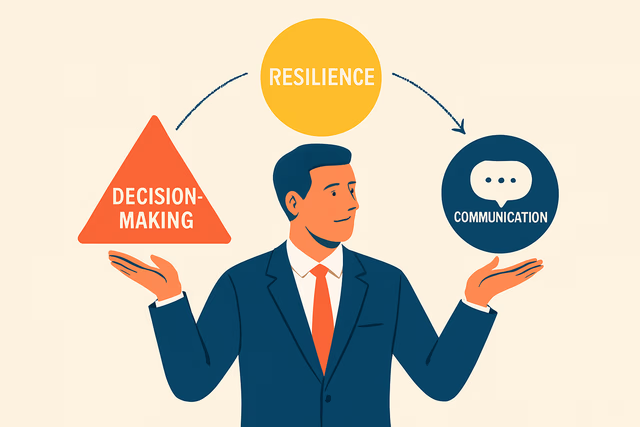
You do not lose trust during transformation because people dislike change in the abstract. You lose it when people believe decisions are being made around them, not with a clear view of what the change will cost their teams. Empathy in leadership matters here because it helps you hear what is underneath the stated objection, communicate tradeoffs without spin, and make harder decisions land with less drag.
Building trust during transformation starts below the surface
The first version of resistance is rarely the real one. A department head says the migration timeline is unrealistic. An operations lead says the rollout will confuse the field. A security partner pushes back on an exception. On the surface, those sound like separate objections. Underneath, they often point to the same issue: people do not yet trust that their constraints have been understood.
That is why building trust during transformation is less about enthusiasm than interpretation. If you only respond to the words spoken in the room, you miss the concern that actually drives behavior. The complaint about timing may be a fear of service disruption. The complaint about process may be a warning about hidden dependencies. The complaint about workload may be a signal that the team has already been through two failed change efforts and is bracing for a third.
Here is the sharp distinction: resistance is often a data source before it becomes a political problem. Treat it like noise and you get delay. Treat it like signal and you get foresight.
A CIO leading an ERP change hears sales call the training plan "too heavy." That can sound like avoidance. It can also mean the quarter is already overcommitted, frontline managers have not been briefed, and the launch will fail unless enablement is resequenced. Empathy does not make that constraint disappear. It lets you see it while there is still time to act.
CIO leadership during transformation requires listening with edge
Listening well is frequently misread as patience or politeness. It is neither. In CIO leadership during transformation, listening is an operating skill. It tells you where trust is thin, where process design is brittle, and where people are smiling in the meeting but preparing workarounds afterward.
Passive listening collects sentiment. Leadership empathy during change looks for structure. You are listening for three things at once: what people fear losing, what dependencies they think you are missing, and what they do not feel safe saying plainly.
That changes the questions you ask. Instead of asking whether a function supports the plan, ask what will break if the plan is right on paper but wrong in sequence. Instead of asking who owns adoption, ask where managers will need to translate the decision into daily tradeoffs. Better questions produce earlier truth.
One short scenario makes the point. The COO asks for a faster automation rollout. The infrastructure team says yes. The service desk says nothing in the meeting, then quietly raises ticket risk two weeks later. If you had listened only for agreement, you would have heard momentum. If you listened for operational friction, you would have heard an unstaffed support model.
Empathy sharpens judgment because it gives context to the facts. Data shows what is happening. Listening shows why people will help, stall, or route around it.
Grow Faster With a Peer Group
Join a curated group of leaders who meet regularly to share challenges, exchange insights, and hold each other accountable. Leadership doesn't have to be lonely.
Explore Peer GroupsCommunicating tradeoffs in leadership is where credibility is won
Trust does not come from telling people everything will work out. It comes from showing that you understand what the decision costs, who absorbs the disruption, and why the trade is still worth making.
This is where many transformation efforts wobble. Leaders communicate the destination and skip the burden. They explain the strategy and soften the operational pain. People notice. Once they sense you are minimizing impact, they stop bringing you the full truth. Optimism without acknowledgment reads as distance.
Communicating tradeoffs in leadership means naming the downside directly. You can say: this will add work for managers in the next sixty days; this will slow feature delivery while we stabilize the core platform; this will retire local flexibility in exchange for reliability and speed later. That kind of language does not weaken your position. It strengthens your credibility because it tells people you are seeing the change from where they sit.
Clarity is kinder than reassurance. Precision builds more confidence than enthusiasm. A difficult decision explained plainly often earns more trust than an easy promise no one believes.
Consider the budget meeting where the CFO asks for faster savings from consolidation. You know the cost target is real, but you also know the proposed timing will strain business continuity. If you present only the savings curve, operations will assume IT is optimizing for finance. If you explain the tradeoff honestly, including what protections you will keep in place, you give the room something sturdier than consensus: informed alignment.
Cross-functional trust grows in the handoff moments
Transformation does not succeed in the strategy deck. It succeeds in the handoffs between functions: when HR translates role changes, when finance adjusts incentives, when operations absorbs temporary friction, when managers explain a new process to teams already at capacity.
That is why cross-functional trust is built less through big speeches than through repeated proof that people were heard, respected, and kept informed. A single ignored dependency can undo a month of careful messaging. A single honest follow-up can restore confidence faster than another all-hands.
You can see this in smaller moments. Product wants to accelerate release cadence after a tooling upgrade. Compliance needs one control step preserved. The old move is to frame compliance as the blocker. The better move is to state the shared outcome, surface the real constraint, and redesign the sequence together. People do not need every decision to go their way. They need evidence that their reality entered the decision.
This is the working contrast at the center of empathy in leadership: inclusion is not the same as indecision. You are not widening the circle to avoid choosing. You are widening the input so the choice is better and the execution is cleaner.
Join a Digital Leadership Session
Our facilitated digital sessions bring leaders together for focused, interactive discussions on the topics that matter most. Learn from peers across industries — from anywhere.
View Digital SessionsA practical heuristic set for leading change with empathy
You do not need a new philosophy to lead change with empathy. You need a few behaviors that keep you close to reality when pressure rises and timelines tighten. Used consistently, they reduce resistance to change because they lower the odds that people will feel surprised, dismissed, or strategically managed.
Use this heuristic set when a decision affects multiple functions or changes how work gets done:
- Name the loss before you sell the gain. People hear strategy better when they know you are not hiding the inconvenience, rework, or local sacrifice involved.
- Ask for constraints, not opinions. Opinions create debate; constraints reveal design flaws, sequencing issues, and staffing risk.
- Separate disagreement from misalignment. Someone can support the direction and still object to the timing, resourcing, or order of operations.
- Close the loop visibly. If people raise a concern, show what changed, what did not, and why. Silence erodes trust faster than an unpopular answer.
These are simple moves, but they have teeth. They keep empathy tied to action rather than sentiment. They also help you avoid the trap of treating listening as a prelude to persuasion instead of a way to improve the decision itself.
Empathy in leadership examples that change the quality of the decision
The value of empathy in leadership becomes clearest when the stakes are high and the options are imperfect. You are choosing timing, sequencing, and tradeoffs under pressure. The question is whether you want to do that with partial information or with a fuller view of what the organization can actually absorb.
One example: a data modernization program is on schedule, but regional leaders warn that reporting changes will hit during annual planning. A blunt approach calls the concern resistance and pushes through. An empathetic leader hears a capacity signal, resets the rollout path, and preserves both credibility and adoption.
Another: a cyber initiative requires tighter controls that business teams see as friction. If you frame it only as policy, you get checkbox compliance. If you acknowledge the extra steps, explain the risk plainly, and adjust workflows where you can, you get cooperation with less quiet sabotage.
The pattern is consistent. Empathy does not replace decisiveness; it improves the quality and reception of decisions. You still choose. You still set direction. But you do it with fewer blind spots and less preventable fallout.
That is the reframe worth keeping: empathy in leadership is not softness added to transformation after the hard decisions are made. It is one of the disciplines that makes hard decisions worth following. For a CIO, that is not about being nicer in the room. It is about being more believable when the room is uncertain.
Accelerate With 1-on-1 Coaching
Work with an experienced coach to develop your leadership style, navigate complex decisions, and unlock your full potential. Personalized guidance, real results.
Apply for Coaching
Written by
Christopher A. SmithChristopher A. Smith is an award-winning, visionary technology leader and entrepreneur passionate about harnessing the collective wisdom of experts to tackle the world's most complex challenges. With over 20 years of leadership and management experience, Christopher has distinguished himself as a pioneer in driving innovation and fostering collaborative ecosystems where ideas flourish and solutions emerge. Christopher's philosophy centers on the conviction that no challenge is too daunting to overcome when individuals come together, pooling their knowledge, skills, and creativity. His career is a testament to the potential of collective intelligence to drive meaningful change, embodying the ideal that there lies the strength to transform the world in unity. Chris is always eager to share his knowledge and experience by speaking at conferences and events. He is passionate about using his skills to contribute to philanthropic organizations and causes where he can make a positive impact.
View all articles