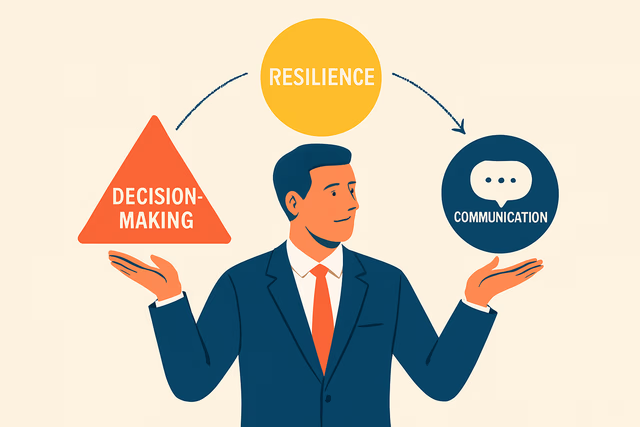
Self-awareness for CIOs is not a soft skill add-on. It is a core leadership capability when enterprise transformation leadership puts you in rooms where technical accuracy is necessary but not sufficient. You rarely lose trust because of one dramatic mistake; you lose it through repeated moments where your intent and other people's experience quietly split apart.
That split gets wider under pressure. The more overloaded the environment, the more your default CIO leadership habits start speaking for you before your strategy does. If you can notice those patterns as they happen, you can strengthen cross-functional trust for CIOs in a way that feels real, not performative.
Self-awareness for CIOs begins where intent and impact diverge
The place to start is simple and uncomfortable: what you mean is not what people necessarily experience. You may think you are being clear, while a commercial peer hears impatience. You may think you are staying calm, while your team reads you as emotionally absent. You may think you are protecting the discussion from noise, while others conclude their concerns will never survive contact with IT.
That is why self-awareness matters so much in transformation. The work itself is cross-functional, political, and time-bound. Your peers are not only evaluating the plan; they are deciding whether you are a leader they can work with when the plan hits resistance.
A quiet pattern shows up in executive meetings. The COO asks whether a platform cutover threatens quarter-end close. You answer with dependencies, environments, and sequencing. Everything you say is correct. It is also not the question they asked.
Trust rarely breaks in a crisis. It thins out in the ordinary meetings before one.
So the first diagnostic question is not, "Am I a trusted leader?" It is narrower: where do people reliably react to you in ways that surprise you? Surprise is useful data. It often marks the gap between your self-perception and your actual impact.
One trust-eroding habit: answering the technical question before the business question
CIO credibility with business peers often slips for a very specific reason: you respond at the wrong altitude. Not because you lack empathy, but because your mind has been trained to move from issue to mechanism. That reflex serves you inside IT. Outside IT, it can sound like you are avoiding the actual decision.
If a finance leader asks, "How exposed are we if this vendor misses the date?" and your first move is a system architecture explanation, you have already made their job harder. They needed a risk frame, a range of likely outcomes, and a recommendation. The architecture may matter later. It does not belong in sentence one.
People do not need less technical truth; they need the technical truth translated to the decision in front of them.
This is one of the more common CIO blind spots because it feels like rigor. From your seat, you are being precise. From theirs, you may be forcing them to do extra interpretive work while the stakes are rising.
A useful reflection prompt is this: when a non-technical peer asks you a question, what is your first sentence usually about — systems, or stakes? If it is usually systems, that habit likely deserves attention. Translation is not simplification. It is leadership.
Grow Faster With a Peer Group
Join a curated group of leaders who meet regularly to share challenges, exchange insights, and hold each other accountable. Leadership doesn't have to be lonely.
Explore Peer GroupsCommunication under pressure for CIOs: when efficiency starts to read as distance
Pressure does not create your blind spots. It amplifies them. The faster the environment moves, the more your default style becomes your executive presence.
Picture a steering committee two days after a serious incident. You shorten your sentences. You cut off circular debate. You move hard toward decision and containment. Inside the technology function, that can look steady and reassuring. Around the rest of the table, it may feel like the emotional temperature of the room has been declared irrelevant.
Under pressure, your habits get louder while your self-perception gets quieter.
This is where trust-building for technology leaders becomes less about message content and more about how your behavior lands. Efficiency is valuable. But if your version of efficiency makes other executives feel managed rather than included, they will start saving their real concerns for side conversations. Once that happens, you still have authority, but you have lost access.
Ask yourself what happens to your tone when the stakes rise. Do you become clearer, or simply shorter? Do people leave with sharper understanding, or with less space to think out loud? The answer tells you a lot about why trust feels strong in calm periods and fragile in live ones.
Another signal: certainty is replacing curiosity
There is a difference between being decisive and becoming hard to engage. The distinction matters because enterprise transformation leadership depends on getting useful information early, especially from peers who do not share your vocabulary.
A CHRO raises concern about adoption risk. Before they finish, you explain the training plan, change schedule, and support model. Again, nothing in your answer is wrong. But you have turned a signal into a briefing. If that happens often enough, people stop bringing you weak signals. Then the risks do not disappear; they arrive later and more expensively.
Authority can end a conversation; credibility keeps it open.
Curiosity is not hesitation. It is a way of testing whether you understand the problem as others are living it. A simple pause — "Say more about where you think adoption breaks" — can do more for trust than a polished answer. It shows that you are not just trying to move the meeting forward; you are trying to see around the next corner.
If you want a clean diagnostic, listen for how often you respond with an explanation versus a question. When your ratio gets too explanation-heavy, your peers may start experiencing you as closed before you intend to be.
Join a Digital Leadership Session
Our facilitated digital sessions bring leaders together for focused, interactive discussions on the topics that matter most. Learn from peers across industries — from anywhere.
View Digital SessionsCross-functional trust for CIOs often rises or falls after the meeting ends
Some habits do their damage in the room. Others do it in the hours after. You can have a productive discussion, visible alignment, and still weaken trust if people leave unclear on what was decided, what was heard, or what will happen next.
This is where small repeated behaviors matter more than charisma. Do you summarize decisions in business language or drift back into IT shorthand? Do you circle back when a peer raised a concern that did not fit the agenda? Do you signal ownership in a way that others can see, or do you assume your intent is obvious?
Small habits accumulate into a reputation before they ever become feedback.
Use these diagnostic questions against your last three cross-functional meetings:
- Where did you answer quickly when the other person was actually asking for interpretation?
- Where did your tone get more efficient and less relational as pressure increased?
- Where did you explain instead of probe?
- Where did the meeting feel aligned, but the follow-through still left others uncertain?
You do not need a score. You need a pattern. If one question keeps surfacing, that is probably not a one-off. It is a habit other people have learned to work around.
Decide which habit deserves attention by looking at frequency, stakes, and audience
Not every rough edge needs immediate correction. The habit worth working on first is the one that appears often, shows up in high-stakes moments, and does the most damage outside IT. That last part matters. Improving trust starts with noticing how your habits land with others, especially the peers who do not naturally share your assumptions.
If business leaders often ask follow-up questions to get to consequences, your translation habit is probably the issue. If meetings get quieter after you speak during tense moments, look at how your pressure style lands. If concerns arrive late, examine whether certainty has crowded out curiosity. If decisions seem clear in the room but blur afterward, focus on how you close and follow through.
This is the useful shift: self-awareness for CIOs is not about becoming more self-conscious. It is about becoming more readable. Your peers do not need a different personality from you. They need to understand what it is like to think with you, disagree with you, and raise risk with you when the stakes are real.
That changes the frame entirely. Trust is not a soft byproduct of leadership. It is one of the systems you are running. And like any system, it is shaped less by what you believe about it than by the patterns other people experience every day.
Accelerate With 1-on-1 Coaching
Work with an experienced coach to develop your leadership style, navigate complex decisions, and unlock your full potential. Personalized guidance, real results.
Apply for Coaching
Written by
Christopher A. SmithChristopher A. Smith is an award-winning, visionary technology leader and entrepreneur passionate about harnessing the collective wisdom of experts to tackle the world's most complex challenges. With over 20 years of leadership and management experience, Christopher has distinguished himself as a pioneer in driving innovation and fostering collaborative ecosystems where ideas flourish and solutions emerge. Christopher's philosophy centers on the conviction that no challenge is too daunting to overcome when individuals come together, pooling their knowledge, skills, and creativity. His career is a testament to the potential of collective intelligence to drive meaningful change, embodying the ideal that there lies the strength to transform the world in unity. Chris is always eager to share his knowledge and experience by speaking at conferences and events. He is passionate about using his skills to contribute to philanthropic organizations and causes where he can make a positive impact.
View all articles