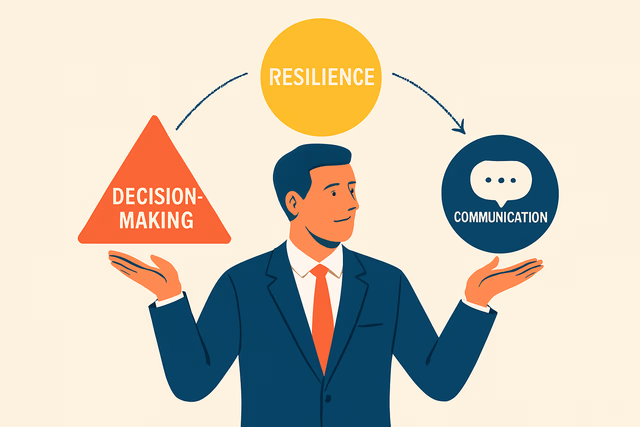
Leadership and management get treated like opposing camps: vision on one side, execution on the other; leaders inspire, managers administer. The split is catchy and mostly wrong. A better introduction to leadership starts here: organizations need both, often from the same person, and the cost of confusing them is not philosophical — it shows up in missed decisions, cross-functional drag, and teams working hard in the wrong direction.
If you are an emerging leader, that distinction matters early. You do not need a bigger title to begin leading, but you do need to know what kind of response a situation actually requires: tighter coordination, clearer direction, stronger alignment, or all three at once.
An introduction to leadership begins with role, not rank
Leadership is not defined by seniority, direct reports, or a box on the org chart. Those things can make leadership easier to formalize. They do not create it.
What is leadership, then? It is the work of setting direction, shaping interpretation, creating alignment, and helping people move before every variable is settled. Management is different work. It plans, coordinates, stabilizes, allocates, and keeps execution reliable. One is not elevated because it sounds bigger. They solve different problems.
That matters because early-career professionals are often told to wait for permission before they act like leaders. Meanwhile, the actual work keeps arriving in more ambiguous forms. A product manager has no direct authority over engineering, design, or sales, but still has to create movement across all three. A senior analyst sees a decision pattern nobody else has named yet and reframes the conversation. The title did not change. The role in the moment did.
A title grants authority. It does not grant followership.
And the reverse is just as important: strong influence without operational discipline is not leadership either. It is just energy. Leadership has to move people somewhere real.
Leadership vs management is a design choice, not a personality test
People often turn leadership vs management into a character judgment. One side gets cast as dynamic, the other as procedural. That framing makes smart people worse at both jobs.
The cleaner way to see the difference between leadership and management is to ask what the situation needs the system to do.
| If the work needs... | Management response | Leadership response |
|---|---|---|
| Predictable delivery | Define tasks, owners, timelines, and controls | Keep teams connected to the purpose so execution does not become drift |
| Cross-functional coordination | Sequence dependencies and remove operational friction | Align competing priorities and build commitment across functions |
| A decision under uncertainty | Gather inputs, clarify trade-offs, document next steps | Frame the choice, name the direction, and help people move without full certainty |
| Performance consistency | Standardize expectations and monitor execution | Reinforce judgment, trust, and shared intent |
| Change | Translate new work into plans and process | Create belief that the change is worth making and survivable to pursue |
Management reduces variance; leadership creates velocity.
That line is easy to over-romanticize, so keep it grounded. If a support organization is missing response-time targets because queue rules are unclear, that is first a management problem. If the support team, product team, and operations team each optimize for different outcomes and nobody owns the trade-off, that becomes a leadership problem. Same company, same week, different need.
The real point is that leadership vs management is rarely a fork in the road. It is a ratio. Some moments need 80 percent management and 20 percent leadership. Others flip the balance.
Grow Faster With a Peer Group
Join a curated group of leaders who meet regularly to share challenges, exchange insights, and hold each other accountable. Leadership doesn't have to be lonely.
Explore Peer GroupsWhere management discipline matters more than inspiration
There is a phase in nearly every growing team where leadership language gets overused because management work feels less glamorous. You hear big talk about ownership and vision while deadlines slip for ordinary reasons: no clear handoffs, no decision rules, no sequencing, no operating cadence.
Execution without direction is efficient drift. But direction without management is theater.
Consider a first-time manager inheriting a team with uneven quality and missed commitments. The wrong move is to start with a speech about excellence. The right move is more ordinary and more useful: clarify priorities, define how work gets reviewed, tighten expectations, and create consistency. People trust leadership faster when the basics stop wobbling.
This is why management deserves more respect than it gets in beginner conversations about leadership for emerging leaders. Planning, coordination, and consistency are not bureaucratic chores. They are what make ambition believable.
A short example: the COO asks why a launch keeps slipping. Marketing says product changed scope. Product says engineering found edge cases. Engineering says approvals came late. Everyone is busy. Nobody is lying. The immediate need is management discipline — one plan, one owner, one sequence. No amount of charisma will replace that.
Leadership shows up when the path is not obvious
Management gets stronger as the work becomes clearer. Leadership gets more important as the work becomes less settled.
When the team does not agree on the problem, when functions see different risks, when the data points in multiple directions, leadership is the act of making a usable path visible. Not a perfect path. A usable one.
That often starts with language. The emerging leader in the room is frequently the person who can say, with precision, what choice is actually being made. Are we debating timeline, strategy, or risk tolerance? Are we trying to optimize margin, growth, or customer trust? Good leadership reduces fog before it increases motion.
Alignment is what lets people move before certainty arrives.
A realistic scene: a cross-functional team is debating whether to ship a feature this quarter. Engineering is worried about reliability, sales wants the revenue story, and legal sees exposure. The manager move is to collect inputs and schedule the review. The leadership move is to frame the choice: "We are not choosing between shipping and not shipping. We are choosing whether first-release learning is worth the operational risk this quarter." That sentence changes the room.
Leadership is not always louder than management. Often it is just clearer.
Join a Digital Leadership Session
Our facilitated digital sessions bring leaders together for focused, interactive discussions on the topics that matter most. Learn from peers across industries — from anywhere.
View Digital SessionsLeading without authority is now normal work
Modern organizations are built around dependencies, not clean vertical lines. That means cross-functional leadership is no longer a special skill for senior executives. It is ordinary work for product leads, operators, senior ICs, program managers, chiefs of staff, and new people managers who need things done through influence rather than command.
This is where many readers first feel the gap between what is leadership and what title-based power can do. You cannot force alignment across functions you do not control. You have to earn it.
Three behaviors matter here more than people admit:
- Clarify direction so others know what matters and what does not.
- Shape decisions by naming trade-offs cleanly instead of lobbying from your silo.
- Build trust through reliability, candor, and visible follow-through.
That is leadership for emerging leaders in its usable form. Not grand speeches. Not borrowed executive mannerisms. Clear thinking people can move around.
A good cross-functional leader also knows when not to posture. If finance needs a sharper forecast, give them the operating assumptions. If design needs a principle, articulate the user trade-off. Influence travels farther when it respects the language of the function receiving it.
The best operators learn to switch modes on purpose
The practical skill is not choosing between leadership and management as identities. It is recognizing which mode the moment requires, then switching without confusion.
Some managers stay too long in management mode because it feels concrete. They keep refining plans after the room has already drifted apart on purpose and priority. Some emerging leaders overcorrect in the other direction. They try to motivate their way through problems that need sequencing, role clarity, and disciplined follow-up.
The stronger move is diagnostic. If the team knows the goal but misses the handoffs, manage. If the handoffs are fine but people are pulling toward different outcomes, lead. If both are true, do both in sequence: create the frame, then build the mechanism.
Protect the system when reliability is the problem. Change the system when the problem is direction.
That distinction helps with management vs leadership examples because it gets you out of abstraction. A weekly project review that exposes blockers and updates owners is management. A conversation that resets what the project is actually for, and gets three functions to commit to the same trade-off, is leadership. A strong operator can do both before lunch.
Accelerate With 1-on-1 Coaching
Work with an experienced coach to develop your leadership style, navigate complex decisions, and unlock your full potential. Personalized guidance, real results.
Apply for CoachingThe real shift is to stop treating leadership as a promotion category
The usual question is, "Am I leading yet, or am I still just managing?" That is the wrong lens. It turns leadership into a status label instead of a response to reality.
A better lens is situational. Every meaningful piece of work asks for some mix of order and movement, discipline and direction, coordination and influence. Management handles the architecture of execution. Leadership handles the architecture of belief and alignment. The work is not to pick a side. The work is to read the moment accurately.
Seen that way, introduction to leadership is not an introduction to authority. It is an introduction to responsibility. Not responsibility for more people, necessarily. Responsibility for more clarity, better judgment, and cleaner movement across ambiguity.
That shift matters because it changes who gets to lead. Not just the person at the top of the chart, but the person who can make the next uncertain step easier for others to take.

Written by
Christopher A. SmithChristopher A. Smith is an award-winning, visionary technology leader and entrepreneur passionate about harnessing the collective wisdom of experts to tackle the world's most complex challenges. With over 20 years of leadership and management experience, Christopher has distinguished himself as a pioneer in driving innovation and fostering collaborative ecosystems where ideas flourish and solutions emerge. Christopher's philosophy centers on the conviction that no challenge is too daunting to overcome when individuals come together, pooling their knowledge, skills, and creativity. His career is a testament to the potential of collective intelligence to drive meaningful change, embodying the ideal that there lies the strength to transform the world in unity. Chris is always eager to share his knowledge and experience by speaking at conferences and events. He is passionate about using his skills to contribute to philanthropic organizations and causes where he can make a positive impact.
View all articles