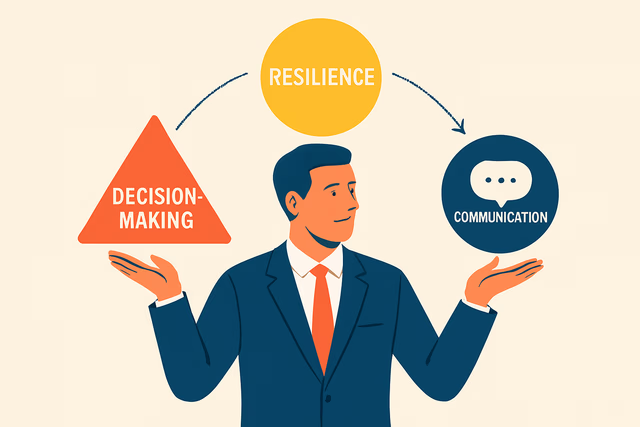
The useful question is not whether supportive networks for CEOs are helpful. It is whether your trusted leadership circle is built to reduce blind spots or simply absorb your stress. During change, those are very different designs, and only one improves decisions.
Why supportive networks break under change
Change exposes a familiar executive trap: the CEO becomes the point where every pressure converges and every signal gets cleaned up before it arrives. Board expectations harden. Direct reports filter. Frontline reality gets translated into something more presentable. The role gains authority and loses texture at the same time.
That is why a supportive network cannot be a popularity circle, an old-friends club, or a loose set of people you call when a decision already feels heavy. A real CEO support network is structured around functions, not affection. Its job is to tell you what the organization is not saying clearly, what the market is signaling early, and where your own pattern recognition is helping or hurting.
Certainty is a performance. Clarity is a system.
I have seen the failure mode in a dozen forms. The CEO announces a reorganization and leaves the room thinking alignment is strong because nobody objected. Forty-eight hours later, the commercial lead is privately worried about customer disruption, the CHRO is hearing manager fatigue, and a plant leader has already slowed implementation to protect local operations. The issue is not resistance. It is that the leader heard agreement instead of reality.
If supportive networks are going to matter, they have to be designed for contrast.
The trusted leadership circle needs four seats
The cleanest model is to stop thinking about people first and think about roles. A useful leadership circle during change usually has four seats, filled by three to five people total. One person can cover more than one role, but every role needs to exist.
- The peer seat: another CEO or senior operator outside your reporting line who understands the pressure of consequential calls and can challenge your framing without internal politics.
- The mentor seat: someone with scar tissue, not just seniority, who can widen the time horizon and keep one bad week from becoming one bad decision.
- The internal truth seat: a leader close enough to execution to tell you what your strategy sounds like on the ground, including who is being overburdened, bypassed, or ignored.
- The dissent seat: a person with explicit permission to test your logic, not your mood. Their value is not opposition. Their value is disconfirming evidence.
This is the operating model. Not advisor, coach, sponsor, friend in the abstract. Seat, function, contribution.
The wrong network gives confidence. The right one gives contrast.
That contrast matters because high-stakes leadership decisions do not need to be carried alone, but they also should not be outsourced. The point of the circle is not to decide for the CEO. It is to improve the quality of what the CEO sees before deciding.
Grow Faster With a Peer Group
Join a curated group of leaders who meet regularly to share challenges, exchange insights, and hold each other accountable. Leadership doesn't have to be lonely.
Explore Peer GroupsWhat peers actually do for decision-making resilience
A peer is the least sentimental seat in the circle and often the most undervalued. Good peer mentors for CEOs do not mainly provide encouragement. They provide pattern recognition at the right altitude. They can tell you whether what feels unique is actually common, whether your urgency is justified, and where your narrative has gone tidy too early.
Picture the moment: revenue is wobbling, a transformation is underway, and a key executive wants to resign after the new structure is announced. Inside the company, every conversation is loaded. A peer outside the system can say what insiders often will not: you are treating a design problem like a loyalty problem, or you are moving too fast for the middle layer to metabolize the change.
That is decision-making resilience in practical form. Not emotional reinforcement. Better calibration.
The standard for this seat is simple: if the person mostly validates your instincts, they are not serving the role. You want someone who can hear your logic, spot the missing variable, and say it plainly enough that you cannot mistake it for encouragement.
Mentors are there to steady the time horizon
Peers sharpen the frame. Mentors steady the sequence.
The mentor seat matters because CEOs under pressure tend to collapse timelines. A difficult quarter starts to feel like a referendum on the entire strategy. A vocal critic becomes proof that the organization cannot handle change. A mentor with real operating experience can separate what is urgent from what is merely loud.
This is where many leaders get the design wrong. They choose a mentor because the person is admired, connected, or reassuring. None of that is enough. You need someone who can help you think in second-order consequences: if you centralize now, what local capability weakens six months from now? If you replace dissent with speed, what information disappears from the system? If you want inclusive leadership during change, where do you need slower listening before faster action?
Trust without challenge becomes comfort. Challenge without trust becomes theater.
That sentence is the test for the whole circle, but it is especially true here. The mentor seat should create psychological safety without becoming a permission slip. If you leave every conversation feeling soothed, you may be getting counsel, but you are not getting guidance.
Join a Digital Leadership Session
Our facilitated digital sessions bring leaders together for focused, interactive discussions on the topics that matter most. Learn from peers across industries — from anywhere.
View Digital SessionsInternal stakeholder support is where inclusion becomes operational
The strongest CEO support systems include peers and mentors, but they fail without internal stakeholder support. Change does not break in strategy decks. It breaks in handoffs, manager bandwidth, customer conversations, and informal status shifts that senior teams notice late.
This is where inclusive leadership during change stops being a values statement and becomes a design choice. If your leadership circle contains nobody who can tell you how decisions land across functions, geographies, or levels, you are not leading inclusively. You are leading from edited inputs.
One short scene says it all. The CEO asks for a faster shift to centralized decision rights. The CFO sees efficiency. The head of operations sees execution risk. A regional leader sees two high performers about to disengage because the new model strips local judgment without explaining the why. Those are not competing truths. They are incomplete truths that need to be held together before the call is made.
In change, exclusion is not a cultural issue first; it is an information failure.
Choose at least one internal voice who sits close to consequence, not just close to power. Sometimes that is a CHRO. Sometimes it is a business unit leader, chief of staff, transformation lead, or respected operator with enough standing to speak plainly. The criterion is not title. It is whether they can translate executive intent into organizational reality and back again.
Design trust so candor survives success
Every CEO says they want candor. Fewer build the conditions that let candor survive after the first visible win.
A trusted leadership circle needs both psychological safety and accountability. Safety means people can surface weak signals, social risk, or unpopular interpretations without being punished for tone or timing. Accountability means they are expected to be specific, evidence-based, and willing to stay in the conversation after disagreement. Without safety, people self-censor. Without accountability, the circle becomes a place for vague concerns and personal preference.
The fastest way to ruin the model is to leave those terms implicit. Tell each person why they are in your circle. Name what you need from them. Ask them where you are easiest to flatter and hardest to confront. Then make the exchange regular enough that feedback arrives before crisis, not only inside it.
A leadership circle should lower the noise floor, not raise the applause volume.
One more scenario: after a successful quarter, the CEO starts hearing cleaner messages from the team. Energy is high. Debate narrows. That is the dangerous moment. Success can create a softer echo chamber than failure because nobody wants to interrupt momentum. The dissent seat matters most when the organization is relieved.
Accelerate With 1-on-1 Coaching
Work with an experienced coach to develop your leadership style, navigate complex decisions, and unlock your full potential. Personalized guidance, real results.
Apply for CoachingBuild the circle by role, not by loyalty
If you are deciding which three to five people belong in your supportive network, start with the decisions ahead of you, not the relationships you already have. A restructuring needs different support than a market expansion. A culture repair needs different internal signal than an integration. The circle should be built around the shape of the change and the kinds of blindness it creates.
That usually means one external peer, one seasoned mentor, and one or two internal stakeholders who see consequences from different angles. Add a dedicated dissent voice if your team is especially deferential or your current environment rewards speed over reflection. Keep the group small enough that it remains candid and distinct. Once two people are giving you the same input from the same vantage point, one of those seats is wasted.
The deeper shift is this: a CEO support network is not there to help the leader feel less alone, though it may do that. It is there to keep the organization from being led by a single, overpressured point of view. Supportive networks are not soft at all. They are structural. They are part of how judgment gets distributed without authority getting diluted.
That is the reframe worth keeping. The trusted leadership circle is not a private aid for a stressed executive. It is decision architecture for change. Build it that way, and what looks like support from the outside becomes something more serious on the inside: a disciplined way to see before you act.

Written by
Jonathon MoodyGrowing up north of Toronto, Jonathon attended the University of Ottawa and began working in Ottawa's thriving tech sector during the late 90s. Jonathon has spent more than 20 years helping organizations change the way they do business through technology.
View all articles