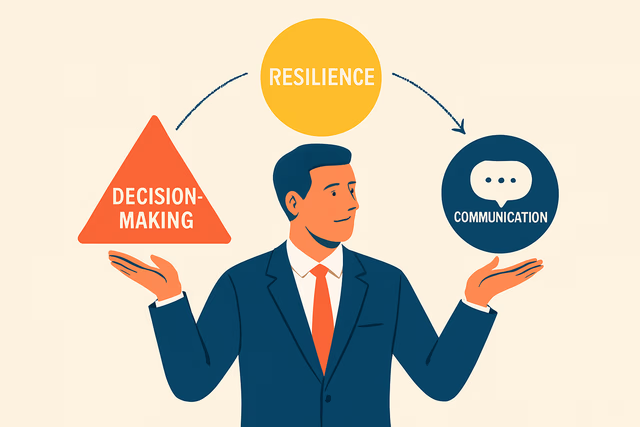
The higher the stakes, the more decisive you need to be—and the less you can afford to lead from a single, rigid mode. That is the contradiction at the center of executive growth: pressure tempts you toward simplification just as the job starts demanding more range. If you want stronger performance without losing team trust, you do not need a harsher persona. You need a broader operating model for how your leadership shows up in decision-making, executive communication, and change leadership.
Why executive growth often narrows at the exact moment it should expand
As your role gets bigger, the environment gets less forgiving. Time compresses. Signal gets noisy. Stakes rise faster than certainty. Under that pressure, many CEOs and senior leaders start overusing the behavior that once made them successful. The analytical operator becomes slower and more closed. The inspirational leader becomes vague. The hard-driving builder starts mistaking tension for discipline.
That is why executive growth so often looks, from the inside, like self-protection. You think you are becoming clearer, but your team experiences you as less readable. You think you are raising standards, but people hear volatility. Pressure does not just test judgment; it exposes default settings.
A board asks for a sharper margin story before the next quarter closes. In the same week, your product team needs room to make a long-cycle bet. If you handle both moments with the same tone, same pace, and same decision logic, one side of the business will get what it needs and the other will not.
Strategic range is not inconsistency; it is consistency applied with judgment. The point is not to become softer or tougher on demand. The point is to become more precise about what the moment requires.
A strategic range framework for CEO leadership
The useful way to think about executive growth is not personality development. It is system design. Your team is constantly reading three things from you: what matters, how decisions get made, and whether the social cost of telling the truth is rising or falling. That reading happens whether you intend it or not.
A practical framework is to look at three arenas of leadership and three trust signals inside each one. The arenas are where your range must expand. The signals are what your team uses to decide whether to trust you under pressure.
- Decision-making tests whether you can be both open-minded and decisive.
- Communication tests whether you can be both candid and steady.
- Change leadership tests whether you can raise standards without creating fear.
Across all three arenas, people are watching for the same trust signals: clarity, credibility, and consistency. Teams do not lose trust because your standards rise. They lose trust when your signals become hard to read.
Clarity means people understand the logic, not just the outcome. Credibility means your words match what you are willing to do. Consistency means your principles hold even when your tone or pace changes. If one signal drops, trust wobbles. If all three weaken at once, performance usually follows.
That framework matters because it shifts the question. Instead of asking, “Am I being strong enough?” you ask, “What range does this situation require, and what signals is my team receiving from me?” That is a better executive question.
Grow Faster With a Peer Group
Join a curated group of leaders who meet regularly to share challenges, exchange insights, and hold each other accountable. Leadership doesn't have to be lonely.
Explore Peer GroupsDecision-making for leaders: widen the aperture, narrow the call
The first place strategic range shows up is in how you decide. Weak leaders often delay. Overcorrecting leaders decide too early and call it conviction. Mature CEO leadership can hold a wider aperture before the decision, then narrow fast once the call is made.
Those are different muscles. Before the decision, range means you can invite dissent, compare time horizons, and separate reversible calls from irreversible ones. After the decision, range means ambiguity drops. Your team should not need to guess whether you are still considering options that you have already ruled out.
Here is where trust often breaks. A CEO says, “I want debate,” then punishes the executive who brings the hardest counterargument. The next meeting gets quieter. Nobody announces that psychological safety has fallen; the quality of information simply gets worse.
Good decision-making for leaders makes the process legible. Say what kind of decision this is. Say what criteria matter most. Say who has input and who has the call. Clarity without care feels cold. Care without clarity feels evasive.
If the issue is strategic, keep the aperture wide long enough to surface real alternatives. If the issue is operational and time-bound, narrow faster and explain why. Your range is visible in the transition. Teams can accept a hard call. They struggle with a moving target.
Executive communication that strengthens team trust under pressure
Once the decision is made, communication carries the weight. This is where leaders often confuse message discipline with emotional flatness. Your team does not need every message to sound calm. It needs your communication to sound coherent.
A reorganization is announced on Monday. By Wednesday, one group hears it is about speed, another hears it is about cost, and a third hears it is about accountability. Even if each statement is partly true, trust slips because the story now looks improvised.
Strong executive communication does three things at once. It names reality without performance theater. It explains what is changing and what is not. And it repeats the core rationale enough that people stop spending energy decoding your intent.
This is where many senior leadership development conversations stay too abstract. Communication range is not about becoming more charismatic. It is about matching your message to the psychological task in front of the audience. An investor update, an executive team debate, and an all-hands after a miss should not sound identical.
Still, the underlying logic should travel. When your rationale changes by room, your credibility changes with it. When your tone changes by room but your rationale holds, people read that as judgment.
A simple test helps here: after a difficult message, can your team accurately explain the decision back to someone else, including the trade-offs? If not, the problem is rarely intelligence. The signal is muddy.
Join a Digital Leadership Session
Our facilitated digital sessions bring leaders together for focused, interactive discussions on the topics that matter most. Learn from peers across industries — from anywhere.
View Digital SessionsChange leadership that protects psychological safety while raising standards
The false choice between performance and team trust becomes sharpest during change. Leaders often assume that if expectations are going up, comfort must go down. That is too crude to be useful.
Psychological safety is not the absence of pressure. It is the confidence that candor will not be punished arbitrarily. High standards and psychological safety work together because performance improves when people can surface risk early, admit misses quickly, and challenge assumptions before they become expensive.
You see the difference in small moments. A leader reviews a missed milestone and asks, “What blocked us that we did not see soon enough?” Another asks, “Who owns this failure?” Both may care about execution. Only one creates conditions for better information next time.
Change leadership with range means adapting the mix of support and demand without becoming unrecognizable. Early in a transformation, people need orientation: what is changing, why now, and where decisions sit. Midway through, they need reinforcement: what behaviors count, what trade-offs are real, and what will no longer be tolerated. Late in the cycle, they need proof that the new standard is durable, not just a temporary surge of executive attention.
Raising standards does not require a harsher identity. It requires cleaner consequences, tighter follow-through, and less sentimental ambiguity. A warm leader who becomes sharper can keep trust. A leader who becomes erratic usually cannot.
How to widen your executive growth range without looking unpredictable
The practical challenge is adoption. If you suddenly start changing your style from meeting to meeting, people may read that as instability rather than range. The answer is to anchor your shifts in explicit signals.
Tell your team what mode you are in and why. “I want broad input before we decide.” “This is no longer a debate; we are aligning execution.” “I am raising the bar here, and I want disagreement early rather than silent compliance.” Those short cues reduce unnecessary interpretation. They make your moves easier to trust.
It also helps to audit your leadership through the three arenas. In decisions, ask whether you are inviting the right dissent before closure. In communication, ask whether your rationale stays intact across audiences. In change leadership, ask whether your standards are becoming clearer or just louder.
Executive growth is not the work of building one stronger leadership voice. It is the work of building a leadership instrument with more notes. Range lets you respond to context without surrendering your center.
That is the reframe worth keeping: trust is not what you preserve by easing off performance pressure. Trust is what you earn when people can see that your higher standards come with clearer judgment, steadier signals, and a wider capacity to lead the moment you are actually in.
Accelerate With 1-on-1 Coaching
Work with an experienced coach to develop your leadership style, navigate complex decisions, and unlock your full potential. Personalized guidance, real results.
Apply for Coaching
Written by
Christopher A. SmithChristopher A. Smith is an award-winning, visionary technology leader and entrepreneur passionate about harnessing the collective wisdom of experts to tackle the world's most complex challenges. With over 20 years of leadership and management experience, Christopher has distinguished himself as a pioneer in driving innovation and fostering collaborative ecosystems where ideas flourish and solutions emerge. Christopher's philosophy centers on the conviction that no challenge is too daunting to overcome when individuals come together, pooling their knowledge, skills, and creativity. His career is a testament to the potential of collective intelligence to drive meaningful change, embodying the ideal that there lies the strength to transform the world in unity. Chris is always eager to share his knowledge and experience by speaking at conferences and events. He is passionate about using his skills to contribute to philanthropic organizations and causes where he can make a positive impact.
View all articles