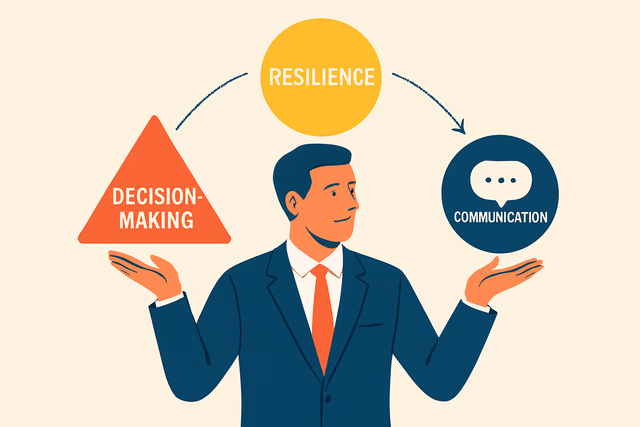
The strongest marketing leaders are not the ones with the busiest conference calendars. They are the ones whose professional connections quietly improve the quality, speed, and durability of their decisions. That is the shift professional connections for CMOs require: away from performative CMO networking and toward a marketing leadership network built for judgment, internal influence, and support when the stakes are real.
Why traditional CMO networking breaks under brand pressure
Brand influence now gets tested in rooms you do not control. Finance questions spend. Product changes the roadmap. Sales wants a message that closes this quarter, even if it weakens the brand next year. In that environment, a wide network is not the same thing as a useful one.
What fails is the old model of networking as visibility. You collect contacts, attend events, trade updates, and still find yourself alone when an actual decision gets hard. A weak network makes every brand decision look political; a strong one lets it look inevitable.
Picture the Monday meeting: the COO wants faster growth, the head of sales wants simpler claims, and legal wants tighter language. You are not short on contacts. You are short on people who can help the brand move through conflict without getting diluted.
That is why you should treat professional connections as a leadership asset. Not because relationships feel nice to have, but because brand leadership depends on trust moving across fragmented channels, teams, and incentives. Influence is not built at the offsite. It is built in the handoff.
A professional connections framework built for decision support
If you design your network well, it should do three distinct jobs for you: help the organization absorb your decisions, help you calibrate those decisions against credible peers, and help you sharpen judgment with someone who has seen the pattern before.
That gives you a simple operating model for professional connections:
- Translation through internal influence: relationships that carry brand decisions across product, sales, finance, operations, and the executive team.
- Calibration through peer credibility: respected peers who can test your thinking and tell you whether the market pressure you feel is real or self-generated.
- Compression through mentor access: experienced leaders who shorten your learning curve when the decision is politically sensitive or strategically irreversible.
The point is not balance for its own sake. The point is function. Different moments expose different gaps.
If your strategy is solid but keeps getting reshaped by other teams, you have an internal influence problem. If you are making decisions in a vacuum, you have a peer credibility problem. If the situation feels novel every quarter, you likely need mentor access more than another peer roundtable.
Peers do not give you answers; they give you calibration. Mentors do not remove risk; they reduce unforced errors. Internal relationships do not replace authority; they make authority usable.
Grow Faster With a Peer Group
Join a curated group of leaders who meet regularly to share challenges, exchange insights, and hold each other accountable. Leadership doesn't have to be lonely.
Explore Peer GroupsInternal influence is the first layer of brand leadership
For a CMO, the most important network often sits inside the building. That can feel unglamorous compared with external reputation, but brand leadership rises or falls on cross-functional relationships.
A rebrand does not stall because the creative is weak. It stalls because product thinks the promise overreaches, sales thinks the story slows deals, and finance thinks the rollout cost arrived at the wrong moment. If those relationships only activate when you need approval, you are already late.
Internal influence works best when you build it around recurring moments of tension, not around org charts. Who regularly shapes how the brand is interpreted, constrained, or accelerated? Start there. The useful relationship is not always the most senior one. Sometimes it is the operator who translates strategy into process, or the sales leader everyone else follows in the room after the room.
You do not need constant contact. You need patterned trust. That usually comes from three habits: sharing context before stakes rise, inviting challenge early enough to matter, and making it clear that brand choices are enterprise choices, not marketing preferences.
One CMO sees support vanish every budget cycle. Another has the same budget pressure, but the CFO already understands how brand spend connects to commercial timing. The difference is not charisma. It is relationship design.
Brand leadership becomes more durable when your internal influence is broad enough to carry the message and deep enough to survive disagreement. Brand is not what marketing says. It is what the organization is willing to repeat consistently.
Peer credibility gives you calibration, not applause
Once your internal base is strong, the next question is whether your judgment is getting sharper or simply louder. That is where peer credibility matters.
You need relationships with respected peers who understand the role at your altitude. Not networking contacts who trade headlines, but people whose judgment you would trust when your own view is too close to the work. A good peer relationship gives you perspective without politics. It lets you test whether a channel shift, agency change, or positioning debate is specific to your company or part of a wider pattern.
A short example: you are under pressure to split brand and demand more aggressively. In your own environment, the request sounds urgent and rational. Two credible peers tell you they made that move and spent the next year rebuilding narrative coherence across regions and teams. That does not make the answer easy. It does make it less lonely and less naïve.
Peer credibility also matters because outside respect often improves internal conviction. If you are hearing informed validation from strong operators elsewhere, you are less likely to overreact to the loudest internal voice. The goal is not borrowed authority. It is cleaner thinking.
Build this part of your marketing leadership network narrowly. Five useful peers are worth more than fifty light connections. You are looking for candor, pattern recognition, and enough mutual respect that neither of you has to perform competence for the other.
Join a Digital Leadership Session
Our facilitated digital sessions bring leaders together for focused, interactive discussions on the topics that matter most. Learn from peers across industries — from anywhere.
View Digital SessionsMentor access strengthens judgment when the decision gets expensive
There are moments in the CMO seat when peer conversation is not enough. You need someone who has seen the cycle before and can help you read around the obvious facts.
That is what mentor access is for. Not inspiration. Not sponsorship theater. Pattern recognition.
A mentor hears your situation and notices what you cannot yet see: the CEO is really testing sequencing, not strategy; the board is reacting to uncertainty, not to the campaign; the acquisition changed the political center of gravity, so your brand architecture debate is partly a power debate. Experience does not guarantee the answer, but it often reveals the real question.
This matters most when the decision carries second-order effects. Should you centralize brand? Replace an agency partner? Push for a category narrative the sales team cannot yet sell? Those are not only marketing calls. They shape trust, timing, and your own staying power.
Mentors shorten the distance between signal and judgment. They help you separate noise from pattern and urgency from consequence.
The best mentor relationships are not constant. They are accessible, honest, and grounded enough that you can bring the unpolished version of the problem. If every conversation feels like a presentation, you do not have mentor access. You have an audience.
Build the network around the decision, not the calendar
Once you see the three domains clearly, the practical question becomes where to invest next. Do not answer that by asking which relationship category sounds most impressive. Answer it by looking at where your brand decisions are currently losing force.
If brand choices keep slowing down inside the company, strengthen internal influence. If you are second-guessing your own calls because you lack external comparison, build peer credibility. If the role is stretching beyond your current pattern library, seek mentor access.
That diagnosis can be surprisingly specific. The COO asks for an AI roadmap. You deliver a brand narrative tied to customer trust. Product is already piloting tools, support has changed workflows, and no one aligned the story. That is not a networking gap in the abstract; it is a gap in internal influence around a strategic shift.
Or you find yourself defending a long-term brand move while the market turns noisy and impatient. A credible peer helps you see whether your discipline is conviction or stubbornness. A mentor helps you judge whether this is the moment to hold the line or change the sequence.
The useful test is simple: which part of your network would make your next hard decision better, faster, or steadier?
That question changes the whole frame. Your professional connections are not a side asset sitting next to the job. They are part of how the job works. The real measure of your network is not who knows your name. It is whether the people around you make the brand easier to lead when the pressure arrives.
Accelerate With 1-on-1 Coaching
Work with an experienced coach to develop your leadership style, navigate complex decisions, and unlock your full potential. Personalized guidance, real results.
Apply for Coaching
Written by
Christopher A. SmithChristopher A. Smith is an award-winning, visionary technology leader and entrepreneur passionate about harnessing the collective wisdom of experts to tackle the world's most complex challenges. With over 20 years of leadership and management experience, Christopher has distinguished himself as a pioneer in driving innovation and fostering collaborative ecosystems where ideas flourish and solutions emerge. Christopher's philosophy centers on the conviction that no challenge is too daunting to overcome when individuals come together, pooling their knowledge, skills, and creativity. His career is a testament to the potential of collective intelligence to drive meaningful change, embodying the ideal that there lies the strength to transform the world in unity. Chris is always eager to share his knowledge and experience by speaking at conferences and events. He is passionate about using his skills to contribute to philanthropic organizations and causes where he can make a positive impact.
View all articles