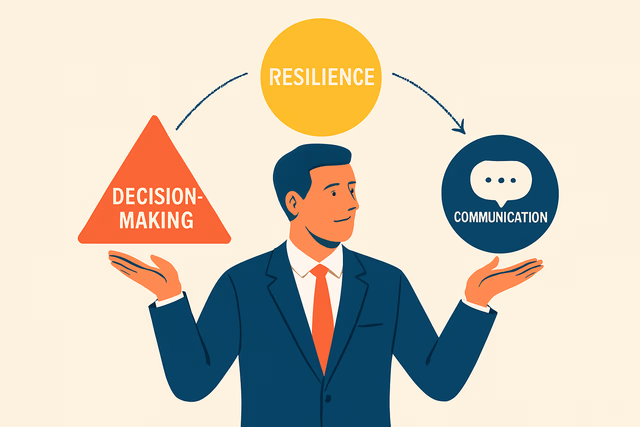
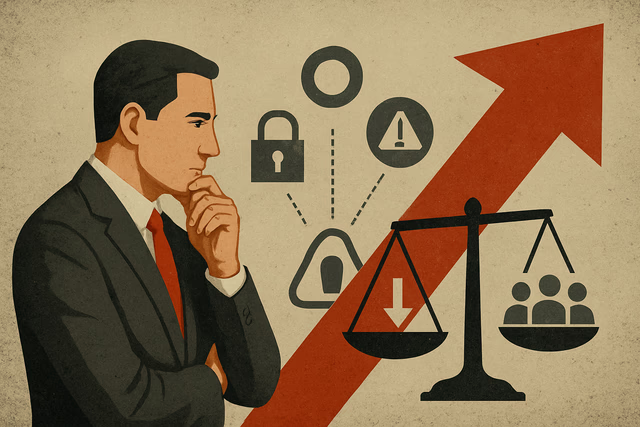
You leave the meeting without a decision, but with three new requests and a growing sense that everyone heard a different proposal. By Friday, finance wants tighter assumptions, operations wants a slower rollout, and your architects are annoyed that a technical constraint has been flattened into "an IT preference." In enterprise transformation, that is the moment that matters. Leadership dynamics shape whether cross-functional trust expands or contracts when pressure rises.
Why leadership dynamics tighten during enterprise transformation
Transformation puts every function under the same headline and inside very different realities. You may be looking at technical tradeoffs between speed, resilience, and integration complexity. Your peers are looking at service continuity, audit exposure, labor impact, customer risk, or budget timing. Nobody is irrational. The trouble is that the same decision carries different consequences depending on where you sit.
A platform choice looks like architecture to you, budget exposure to finance, control drift to risk, and workflow friction to operations. Once you see that, the meeting changes. What felt like resistance is often a collision of legitimate interpretations.
Change fatigue makes this sharper. Early in a transformation, people will tolerate ambiguity if they believe the direction is sound. Six months later, after process shifts, staffing pressure, and a few promises that took longer than expected, tolerance drops. A new proposal is no longer evaluated on its own merits. It is judged against the organization’s recent memory.
Picture the rollout discussion for a new data model. Your team sees a necessary foundation for later automation. The COO hears another quarter of disruption. The CHRO hears retraining demand for teams that are already stretched. Trust starts to erode not because people reject the idea, but because they doubt the organization can carry one more unresolved dependency.
Cross-functional trust is part of execution, not separate from it
CIO leadership often gets described as translation, influence, or stakeholder management. All true, but still a little too polite. During transformation, trust is an execution system. If your peers trust how a decision is being framed, they will stay in the work even when the answer is uncomfortable. If they do not, every decision gets reopened two meetings later.
That is why technical persuasion alone so often disappoints. You can win the architecture argument and still lose the operating decision. The room may agree that your recommendation is technically sound and still hesitate because nobody is clear on the downstream implications, the residual risk, or who owns the consequences.
When trust is weak, every meeting becomes discovery, negotiation, and re-litigation at once.
You can see this in small moments. A CFO asks for one more pass at the model, not because the math is wrong, but because the risk transfer is still fuzzy. A business leader says, "I support the direction," while quietly waiting to see whether operations will absorb the disruption. What appears to be delay is often a signal: the decision is underdesigned.
Grow Faster With a Peer Group
Join a curated group of leaders who meet regularly to share challenges, exchange insights, and hold each other accountable. Leadership doesn't have to be lonely.
Explore Peer GroupsA leadership dynamics framework for stakeholder alignment
What helps is a simple operating model for trust-building, one that reduces ambiguity without pretending uncertainty is gone. You do not need a grand communications plan. You need a decision frame people can work inside.
I think of that frame as a trust loop with four design moves:
- Decision: name what is being decided now, and what is not.
- Implications: translate each option into business consequences, not technical description.
- Uncertainty: say what remains unknown and how you will learn fast enough.
- Ownership: assign shared responsibility for what follows the decision.
The sequence matters. If you start with technical detail, non-technical peers have to infer the business stakes for themselves, and they will do it through the lens of their own exposure. If you skip uncertainty, people assume you are hiding it. If you skip ownership, support stays verbal and evaporates under pressure.
Clarity is not certainty. It is the discipline of making consequences visible before they become surprises.
This is what gives the model practical force: it is built to move decisions forward. Not by removing tension, but by organizing it.
Clarify the decision before you explain the technical tradeoffs
A surprising amount of friction comes from talking about a solution before the room agrees on the decision. Are you deciding whether to proceed, which option to choose, what risk threshold is acceptable, or what sequence is realistic? If that is muddy, even good discussion becomes circular.
Your non-technical peers do not need the whole architecture. They need to understand what choice is in front of them and what changes depending on the answer. That means leading with implications, risks, options, and timing.
Say you are proposing a phased modernization rather than a full replacement. Do not begin with system diagrams. Start with the decision: whether the organization wants lower near-term disruption with longer coexistence cost, or faster simplification with higher transition strain. Now the technical tradeoffs are attached to business consequences the room can actually evaluate.
This is where CIO leadership becomes more disciplined than explanatory. You are not simplifying because the audience cannot handle complexity. You are sequencing complexity so the decision can hold.
A good test is simple: after five minutes, can each peer describe the choice in language their own function would use? If not, you are still presenting information, not structuring a decision.
Join a Digital Leadership Session
Our facilitated digital sessions bring leaders together for focused, interactive discussions on the topics that matter most. Learn from peers across industries — from anywhere.
View Digital SessionsReduce ambiguity without pretending uncertainty is gone
Trust breaks when leaders confuse confidence with certainty. During transformation, people can handle unknowns. What they struggle with is hidden uncertainty or uncertainty that keeps changing shape depending on who asks.
So name the unknowns cleanly. What is assumed? What is proven? What is contingent? What would change your recommendation? That is how you reduce ambiguity. Not by claiming more precision than the situation deserves, but by putting boundaries around what is unresolved.
A risk leader will usually stay with you longer if you say, "We know the control impact in the core workflow, but not yet in the exception paths, and here is when that testing completes," than if you flood the discussion with certainty theater. The same goes for operations and finance. Mature peers do not need certainty. They need a stable map of the uncertainty.
Technical detail without implication creates distance. Uncertainty without structure creates anxiety. Put the two together properly, and you create working trust.
One short scenario makes the point. A cybersecurity upgrade reaches committee review. Your team presents confidence scores and vendor benchmarks. The business pushes back. Not because they doubt the technology, but because nobody has said what service disruption is acceptable during cutover, or who decides if rollout pauses. The issue is not knowledge. It is unowned ambiguity.
Shared ownership is what turns cross-functional trust into momentum
The final move is the one many transformation efforts skip. You can create clarity, surface risk concerns, and still stall if ownership remains parked inside IT. Shared ownership matters more than technical persuasion because transformation crosses operational boundaries by definition.
That does not mean everyone owns everything. It means each function owns the part of reality it controls once the decision is made. Finance may own the funding trigger for phase two. Operations may own readiness criteria for cutover windows. HR may own role transition support. You may own dependency management and technical sequencing. Once those commitments are explicit, stakeholder alignment gets sturdier because support is no longer symbolic.
Shared ownership is slower at the front end and faster everywhere else.
For your next high-stakes conversation, walk in with a decision frame, not a defense brief. Spell out the choice, translate the implications, mark the uncertainties, and make ownership visible before the room asks for it. That is how decisions progress with more clarity and less positional arguing.
Seen that way, leadership dynamics are not about getting non-technical peers to buy into your technical position. They are about designing a conversation where the business can make a real choice under technical reality. The CIO who does that is not just explaining transformation. You are helping the enterprise learn how to decide together while it changes.
Accelerate With 1-on-1 Coaching
Work with an experienced coach to develop your leadership style, navigate complex decisions, and unlock your full potential. Personalized guidance, real results.
Apply for Coaching
Written by
Christopher A. SmithChristopher A. Smith is an award-winning, visionary technology leader and entrepreneur passionate about harnessing the collective wisdom of experts to tackle the world's most complex challenges. With over 20 years of leadership and management experience, Christopher has distinguished himself as a pioneer in driving innovation and fostering collaborative ecosystems where ideas flourish and solutions emerge. Christopher's philosophy centers on the conviction that no challenge is too daunting to overcome when individuals come together, pooling their knowledge, skills, and creativity. His career is a testament to the potential of collective intelligence to drive meaningful change, embodying the ideal that there lies the strength to transform the world in unity. Chris is always eager to share his knowledge and experience by speaking at conferences and events. He is passionate about using his skills to contribute to philanthropic organizations and causes where he can make a positive impact.
View all articles